How Programmable Infrastructure Is Redefining the Economics of Financial Services
For centuries, finance has relied on intermediaries to bring order to uncertainty.
Banks connect depositors with borrowers. Brokers link buyers to sellers. Insurers evaluate risk. Compliance officers enforce regulations. Account managers coordinate documents, payments, and client relationships.
These institutions perform the essential functions every economy depends on: managing risk, enforcing contracts, resolving exceptions, and establishing trust.
Yet beneath these critical human responsibilities lies a vast, invisible mountain of administrative mechanics:
- Verifying documentation.
- Confirming contract conditions.
- Moving data across disconnected software systems.
- Reconciling ledger payments.
- Updating record states.
- Following up on routine multi-step workflows.
Intermediation handles trust, but it also carries immense operational friction. The critical question for the next decade of financial evolution is therefore whether the procedural execution behind these decisions can become code.
From Digital Rails to Programmable Logic
A smart contract is fundamentally straightforward: software that executes predefined actions the moment verified conditions are met.
If a verified payment lands, then release the bill of lading.
If an identity check passes and terms are accepted, then disburse funds.
If a repayment is recorded, then instantly update the ledger balance.
This capability does not mean every financial decision can or should be automated. Rather, it unlocks a critical separation: separating predictable execution from human judgment.
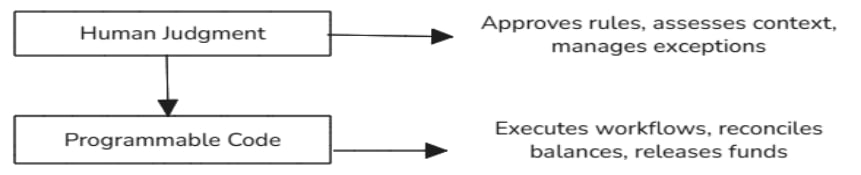
A credit committee still decides whether to underwrite a loan. A relationship officer still steps in when a client encounters hardship. A compliance leader still investigates suspicious activity. But once a decision is made, the execution no longer requires a chain of manual handoffs.
Central banks and international institutions are already testing this architectural shift. The Bank for International Settlements (BIS) and the Federal Reserve Bank of New York explored this concept through Project Pine, an experimental prototype examining how smart contracts could manage central bank liquidity operations, reserve interest calculations, collateral management, and asset swaps in a tokenized ecosystem.
Project Pine was a research prototype without deployment, but its implications are profound: global financial architects are actively reimagining execution logic as a core component of shared infrastructure.
The Ethiopian Context: Moving Beyond Access to Automation
Ethiopia’s financial ecosystem has achieved extraordinary velocity in digital onboarding and payments. The National Bank of Ethiopia (NBE) reported that mobile money accounts crossed 128.5 million by late 2024, with annual digital transaction volumes reaching approximately 9.7 trillion birr.
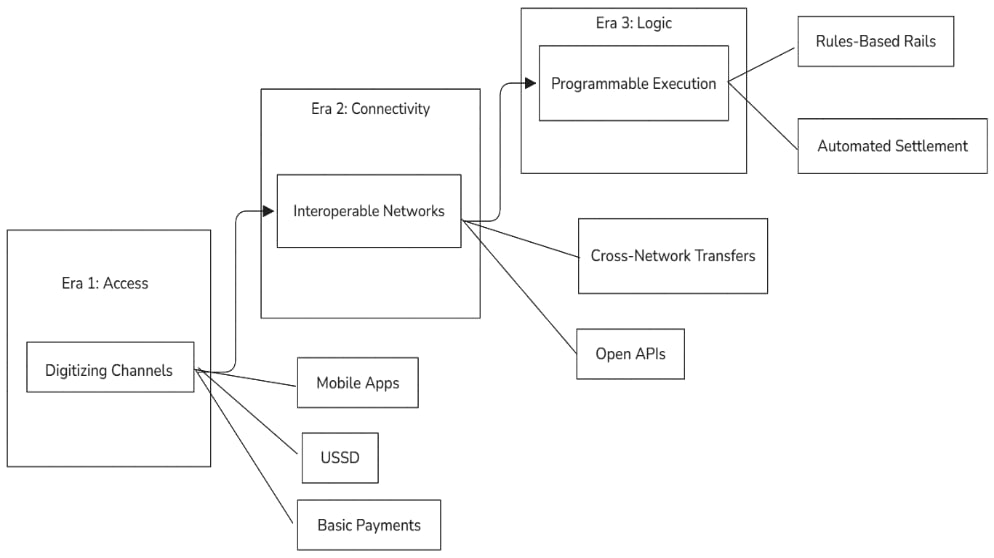
The first era of digital finance focused on access:
- Can a user open an account on a mobile device?
- Can a merchant accept a digital payment?
- Can money move across accounts without a physical branch visit?
These foundations are now laid. The next frontier is depth. It is no longer just about moving money digitally; it is about making the operational logic surrounding money programmable.
Consider an Ethiopian business applying for working capital. Today, the journey moves through sequential friction points:

While credit evaluation requires nuanced risk judgment, the surrounding steps are largely procedural.
In a programmable environment, once an approval decision is reached, downstream workflows trigger automatically:
- Verification of digital identity or invoice data instantly triggers disbursement.
- Micro-repayments from daily merchant sales automatically update outstanding debt balances.
- System logs reconcile without requiring distinct operations teams to manually export and cross-reference spreadsheets.
The bank remains intact. The loan officer remains essential. The institution retains its client relationship. What shrinks is the expensive administrative lag between intent and execution.
Execution vs. Judgment: The Reality of Automation
Misunderstandings around automation usually stem from a single misconception: assuming that automating process steps means replacing people. In modern financial architecture, the clearer division is functional:
Domain | Primary Operational Focus | Best Handled By |
Execution | Document verification, rules enforcement, payout triggers, ledger updates | Programmable Software |
Judgment | Context evaluation, fraud investigation, credit restructuring, client advisory | Financial Professionals |
Take compliance monitoring. Software can audit millions of transactions per second against explicit regulatory parameters, flagging anomalies in real time. Compliance specialists are then freed from manual record-skimming to focus their expertise on complex, ambiguous cases.
The governing framework remains clear:
People establish the rules and exercise judgment. Code executes the routine.
Programmable Infrastructure as the Interoperability Engine
Smart contracts are merely a feature; the overarching opportunity is programmable financial infrastructure.
Imagine a financial ecosystem where identity systems, payment rails, credit registries, and collateral engines interact through shared, rule-based protocols rather than manual handoffs:
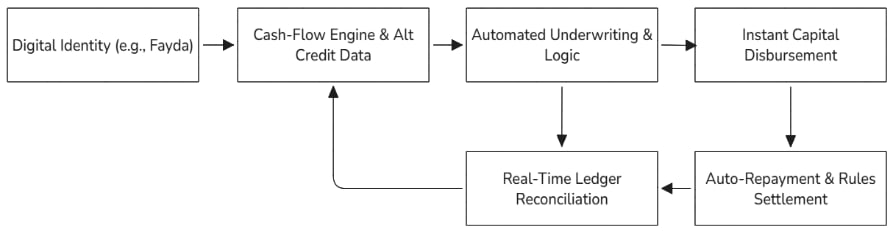
This dynamic is especially vital in markets where financial data is historically fragmented across banks, telecom wallets, microfinance institutions, tax records, and trade registers. While interoperability allows these disparate platforms to speak to one another, programmability enables them to act on information automatically.
This vision aligns directly with Ethiopia’s financial roadmap. The NBE’s draft National Digital Payments Strategy 2026–2030 (BRIDGE 2030) places explicit emphasis on open data exchange, interoperable rails, digital identity integration, and credit expansion beyond basic payment capabilities.
When infrastructure can execute rules rather than merely stream data, high-impact financial products become operational at scale:
- Parametric Micro-Insurance: External satellite drought data automatically triggers immediate claims payouts to smallholders without manual claims processing.
- Trade & Supply Chain Finance: Letters of credit and invoice factoring disburse capital instantly upon digital confirmation of shipping documents.
- SME Micro-Lending: Working capital rules automatically calculate credit limits, adjust interest rates, and manage collection schedules based on live cash flow.
Why Code Still Requires Human Context
Programmable systems are not autonomous or self-governing. Code executes logic ruthlessly, but it cannot interpret context:
- Software registers a missed loan payment; it cannot understand that a supply-chain delay caused a temporary cash crunch worthy of a repayment extension.
- Software flags an unusual transaction pattern; it cannot discern between a novel financial crime and a legitimate, high-value commercial deal.
- Software fulfills technical contract conditions; it cannot resolve a commercial dispute arising from ambiguous real-world performance.
Real-world financial systems exist in dynamic economic environments. Programmable rails depend on reliable external data feeds, clear legal frameworks, robust risk controls, and active human oversight.
The ultimate lesson from initiatives like Project Pine is not that code eliminates institutions, but that institutions equipped with programmable code operate with dramatically lower cost structures, greater transparency, and superior speed.
The Next Financial Layer
The evolution of financial technology unfolds across three distinct eras:
The future financial professional will spend significantly less time moving documents, checking routine conditions, and manually reconciling accounts—and far more time analyzing risk, interpreting complex data, managing relationships, and advising clients.
The value of a banker or credit officer has never resided in their ability to pass a file from one desk to another. Their true value lies in human judgment, contextual understanding, and accountability when circumstances fall outside the rules.
Programmable finance does not eliminate the middleman. It eliminates the repetitive administrative grind leaving behind a faster, more responsive financial system powered by software, but guided by human judgment.